Using local LLMs to find sensitive data before masking
Most teams want realistic data for development, testing, analytics, demos, and model training. The hard part is giving teams useful data without exposing the real people, accounts, and messages behind it.
May 14, 2026Local LLMData MaskingPrivacy
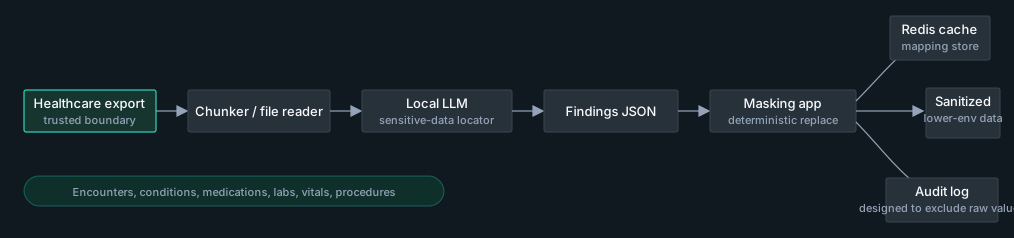
Reference architecture for healthcare data such as encounters, conditions, medications, vitals, labs, procedures, and care plans.
The risk with realistic data
Production data is useful because it has the patterns teams need. It has real shapes, edge cases, missing fields, strange notes, and relationships between records.
But using production data directly creates risk. Names, IDs, emails, phone numbers, addresses, account numbers, and free-text notes can leak into lower environments, demos, dashboards, or training jobs.
The pattern: local LLM as a locator
The useful pattern is not asking the model to generate the final dataset. Instead, use a local LLM as a sensitive-data locator inside the trusted environment.
The model reads chunks of files and returns structured findings: what looks sensitive, what type it is, and where it appears. Then a normal application does the replacement with fake-but-consistent data.
That separation matters. The LLM helps with understanding. The application keeps control.
LLM flags candidates
The local model flags candidate sensitive values in messy files and unstructured text for deterministic handling and validation.
App replaces
The application performs deterministic replacement with fake-but-consistent values.
Cache preserves
Redis keeps the same person, ID, or number mapped across files.
Audit tracks
The audit layer is designed to record the workflow while excluding raw sensitive values from audit events.
How the flow works
A chunker reads files or exports and sends small sections to the local model. The model returns JSON findings with exact positions. A masking application replaces those values with realistic fake values.
A cache like Redis stores the mapping. If "Jane Lee" becomes "Maria Santos" in one file, the same original value gets the same replacement in the next file. The same rule applies to IDs, emails, phone numbers, account numbers, and other fields.
The audit layer stores what rule ran, when it ran, and how many values were replaced. It does not need to store raw sensitive values.
Where this applies
For healthcare, this can cover Primary Care Encounters, Emergency Room Encounters, Symptom-Driven Encounters, Conditions, Allergies, Medications, Vaccinations, Observations and Vitals, Labs, Procedures, and CarePlans.
Primary Care Encounters
Emergency Room Encounters
Symptom-Driven Encounters
Conditions
Allergies
Medications
Vaccinations
Observations / Vitals
Labs
Procedures
CarePlans
The same architecture also works across many other domains:
Support systems: tickets, chat logs, customer messages
Why this improves team experience
Engineering, QA, analytics, support, and AI teams can work with useful data without waiting for manual cleanup or asking for risky access. The dataset still looks realistic. Records still connect to each other. But the sensitive values are replaced.
This gives non-production teams useful structure while security teams keep a stronger boundary around real data.
It also supports incident investigation. When a production error depends on a specific data shape, the same pattern can be recreated in a new ephemeral environment with sanitized data. Engineers can reproduce the issue from representative structure and share the environment without exposing real patient, customer, or account data.
Practical benefits
Local boundary: sensitive-data detection can run inside the controlled environment
Explicit API scope: large raw datasets do not need to become external model inputs
Relational consistency: replacement values can preserve useful links across records
Reproducible error shapes: teams can recreate representative cases in ephemeral environments
Repeatable sanitization: the same approved rules can run across datasets
Versioned controls: prompts, schemas, rules, and outputs can be tracked
The bigger point
Local LLMs do not need to replace traditional data tooling. They can become a layer in the pipeline, especially where unstructured text makes rule-based detection difficult.
For sensitive data workflows, the combination is strong: local LLMs for understanding, deterministic systems for control.
Need safer lower environments?
LetuxTech builds private AI pipelines that find sensitive data, mask it safely, and keep useful structure for development, testing, analytics, and AI work.
We help choose the model, design the replacement rules, set up the cache and audit layer, and deploy the workflow inside your security boundary.